Bill Kenney is the Founder of MEET, where he helps international B2B and B2G companies scale in the U.S. through strategic trade shows, events, and meaningful connections. Since 2012, Bill has guided overseas-based businesses through the complexities of American market expansion, using his hands-on event expertise to turn trade show participation into measurable growth. We're proud to feature Bill as one of our trusted partners supporting international companies on their U.S. growth journey.
For companies expanding into the United States, trade shows can be one of the fastest ways to meet prospective customers, validate market demand, and begin building a sales pipeline. They also represent one of the largest marketing investments many organizations will make during the early stages of expansion.
Because of that, budgeting for trade shows should never be viewed as an administrative exercise. It is a strategic decision that influences where a company invests its time, how quickly it learns about its target market, and how efficiently it converts opportunities into long-term growth.
At MEET, we recommend approaching trade show budgeting with a clear objective. During the first 12 to 24 months of U.S. expansion, the priority should be establishing sales traction and validating a repeatable sales model that can support future growth. Every event, every dollar invested, and every conversation should contribute to that objective.
This guide introduces the principles behind effective trade show budgeting and explains why a strategic approach often delivers stronger results than simply attending the largest or most well-known events.
One of the most common mistakes companies make is beginning with a list of trade shows they would like to attend, then building a budget around those events.
A more effective approach is to define what success looks like first.
According to MEET's recommended framework, companies in the traction phase of U.S. expansion should focus on:
These objectives influence every budgeting decision that follows.
Rather than asking how many trade shows can fit within the available budget, companies should ask which events are most likely to help them achieve these goals.
Trade shows are often planned one event at a time.
A booth is booked, travel is arranged, marketing materials are produced, and attention shifts to the next exhibition.
This approach makes it difficult to manage costs strategically because each event is treated as an isolated activity.
Instead, companies should develop an annual event program that aligns with their commercial objectives.
Planning across an entire year allows organizations to:
An annual budget also makes it easier to adjust investments as market knowledge and sales traction develop.
One of the key principles within MEET's U.S. expansion strategy is customer density.
Customer density means concentrating efforts on one industry vertical and one geographic region until meaningful traction has been established.
This philosophy affects far more than sales strategy. It should also influence how companies allocate their trade show budgets.
MEET explains that the first sale is always difficult to secure. The second sale becomes easier when it has proximity to the first, whether through geography, industry, or both. As additional customers are added within the same market, the benefits of that focused approach continue to compound.
Rather than spreading resources across multiple industries and regions, companies can build credibility and relationships within a clearly defined market.
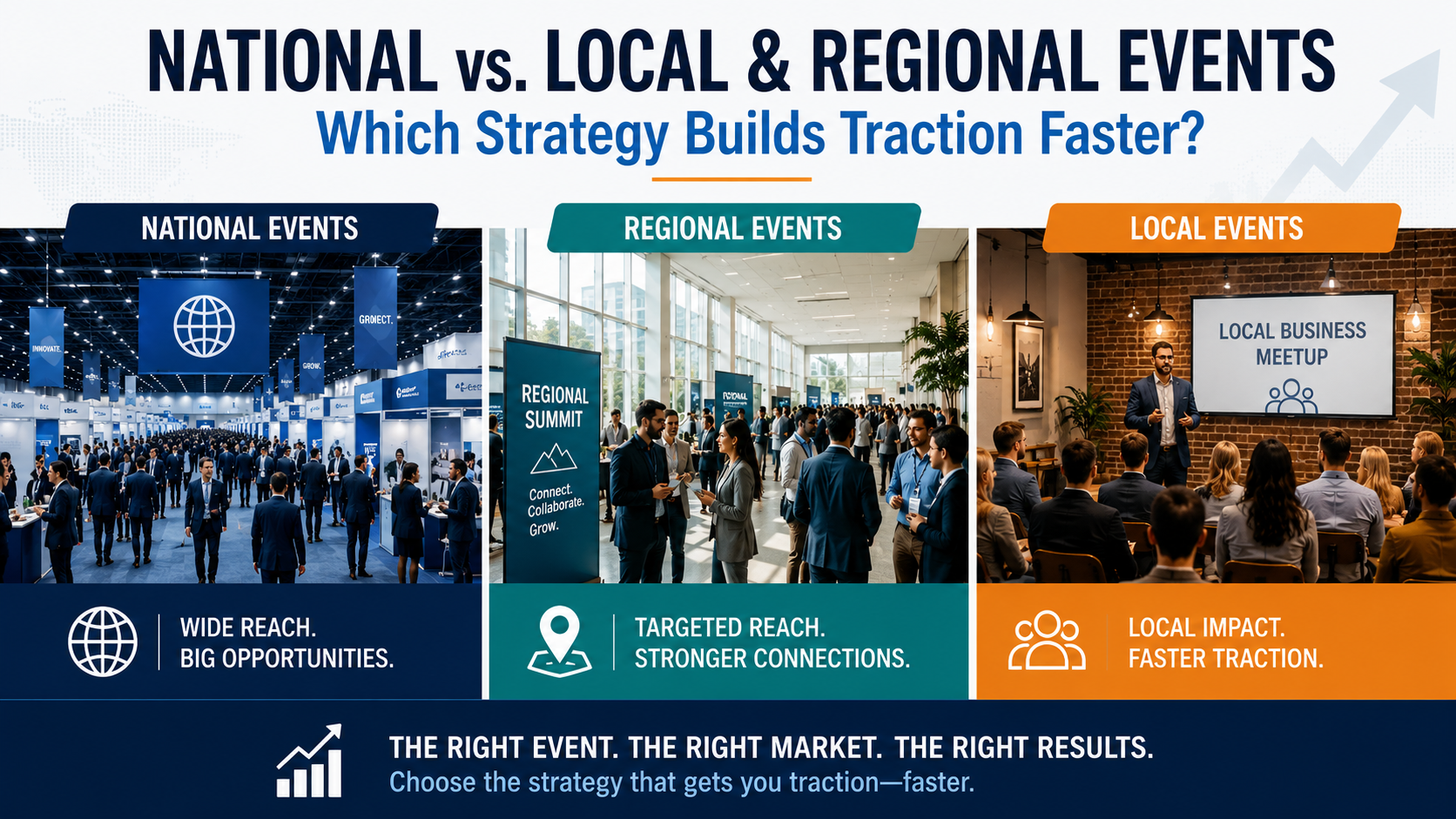
Many organizations assume that exhibiting at large national trade shows is the quickest path to success.
Large events certainly provide access to substantial audiences, but they also require significant financial and operational investment.
MEET's national event strategy assumes participation in four national trade shows each year, using a 10 x 10 foot booth, with four staff members attending each event. Under those assumptions, the recommended annual budget ranges from approximately $200,000 to $600,000, with $400,000 suggested as a representative planning budget.
While these events create valuable opportunities, MEET also identifies several challenges associated with relying primarily on national exhibitions.
These include:
For companies still establishing their U.S. presence, these factors can reduce the overall effectiveness of an event program.
Rather than concentrating resources into only a few national exhibitions, MEET recommends that companies in the traction phase consider a local and regional event strategy.
This model assumes participation in approximately 24 events each year, including local meetups, chapter events, tabletop exhibitions, and regional conferences. Typically, one or two staff members attend each event.
The suggested annual investment ranges from $50,000 to $250,000, with $150,000 serving as a representative planning figure.
This strategy offers several practical advantages.
Companies remain visible throughout the year rather than concentrating activity into only a few weeks.
Sales teams have more opportunities to refine their messaging.
Relationships develop through repeated interaction.
Learning happens continuously rather than annually.
Most importantly, companies can build momentum within a defined market before expanding into additional industries or regions.
Trade show costs extend well beyond booth space.
MEET's budgeting model for a national 10 x 10 exhibit includes numerous cost categories that should be considered during planning, including:
Looking at the complete picture helps companies develop realistic budgets and reduces the likelihood of unexpected expenses.
Future articles in this series will examine each of these categories in greater detail.
A well-planned trade show budget is not simply a way to control spending.
It provides a framework for making strategic decisions throughout the year.
An effective budget helps companies determine:
When these decisions are made in advance, companies can focus less on managing logistics and more on creating meaningful customer conversations.
One of the strongest themes throughout MEET's guidance is that companies should focus on building traction before expanding their event strategy.
This means identifying a target industry, selecting a target geography, and participating consistently in events where prospective customers are most likely to be found.
Once a repeatable sales process has been established, companies can gradually expand into larger national exhibitions and broader markets.
Rather than trying to achieve nationwide visibility immediately, organizations build a stronger foundation through focus, repetition, and continuous learning.
Successful trade show budgeting begins with strategy rather than spreadsheets. Companies should define their commercial objectives before selecting events or assigning budgets.
Planning an annual event program provides greater control than budgeting one exhibition at a time.
Customer density should guide event selection during the early stages of U.S. expansion.
Local and regional events can provide more frequent opportunities to build relationships, refine messaging, and establish sales traction.
Trade show budgets should account for the full cost of exhibiting, including logistics, staffing, marketing, and contingency planning.


We use cookies to enhance your experience, analyze traffic, and support our marketing efforts. Privacy Policy