Bill Kenney is the Founder of MEET, where he helps international B2B and B2G companies scale in the U.S. through strategic trade shows, events, and meaningful connections. Since 2012, Bill has guided overseas-based businesses through the complexities of American market expansion, using his hands-on event expertise to turn trade show participation into measurable growth. We're proud to feature Bill as one of our trusted partners supporting international companies on their U.S. growth journey.
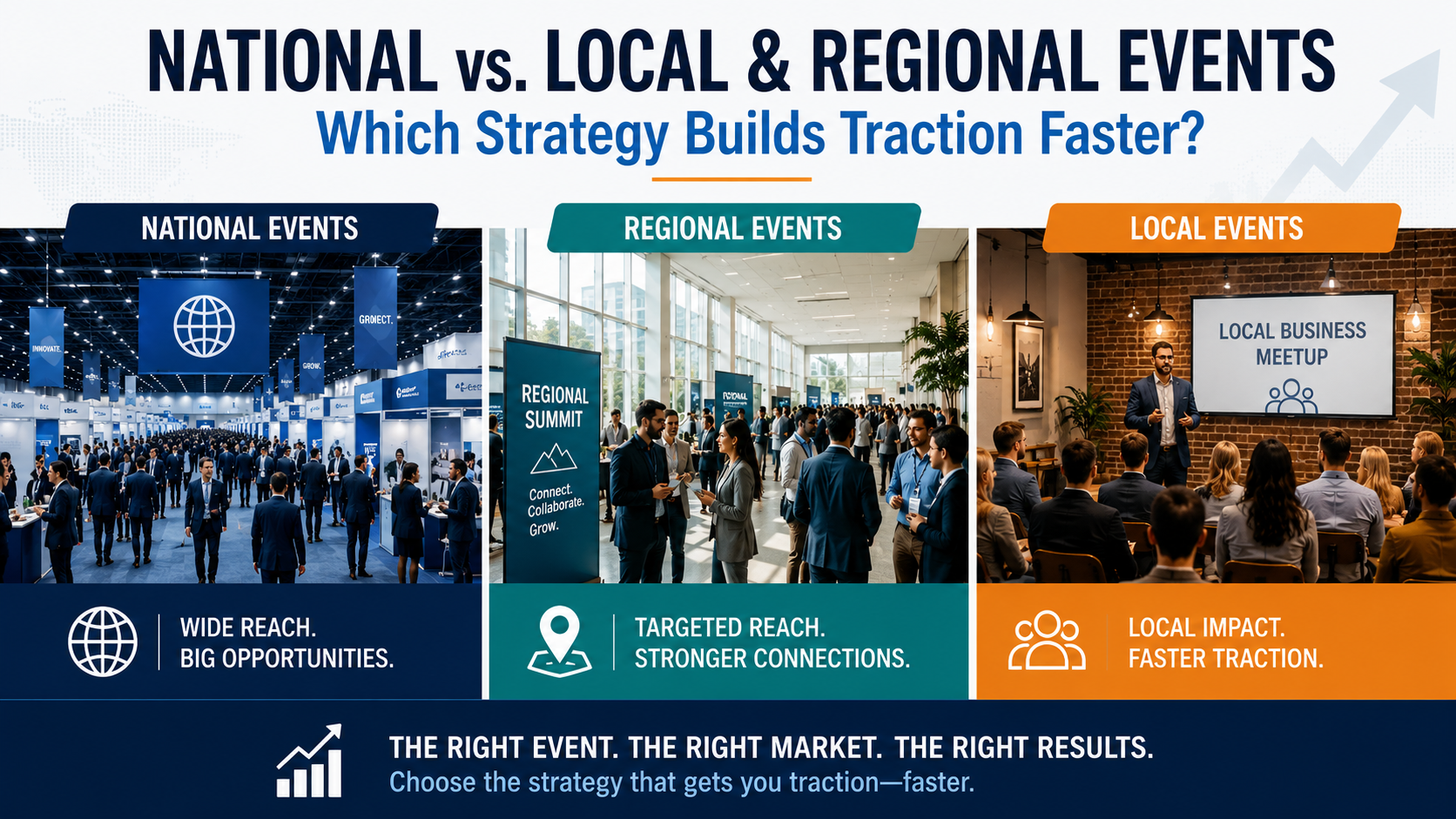
Choosing which events to attend is one of the biggest decisions a company will make when planning its U.S. expansion strategy. For many organizations, the instinct is to secure a booth at the largest national trade shows, assuming that bigger events naturally produce better business opportunities.
While national exhibitions certainly have their place, size alone does not guarantee success. In fact, companies that are still establishing themselves in the U.S. market often achieve stronger results by focusing on smaller, more frequent local and regional events.
At MEET, we encourage companies in their first 12 to 24 months of U.S. expansion to think carefully about where their event budget will have the greatest impact. The goal is not simply to generate activity. The goal is to build repeatable sales traction and create a foundation for sustainable growth.
National trade shows are appealing for obvious reasons.
They attract large audiences, bring together major industry players, and create opportunities to meet a wide range of prospective customers in one location. Many also receive significant media attention, making them attractive destinations for companies looking to increase brand visibility.
For organizations with established sales teams, mature marketing operations, and proven products, these events can play an important role within an overall event strategy.
However, companies entering a new market face a different challenge.
Success is rarely determined by the number of people walking past a booth. Instead, success depends on finding the right prospects, developing meaningful conversations, and creating opportunities that can move through the sales process.
This distinction is important because attending a large exhibition requires a significant investment of both money and internal resources.
MEET's recommended budget model for a national event strategy assumes:
Under these assumptions, an annual investment typically falls between $200,000 and $600,000, with approximately $400,000 suggested as a representative planning budget.
This represents a substantial commitment for any organization, particularly one still validating its U.S. expansion strategy.
The financial investment is only one part of the equation. Time, staffing, logistics, and opportunity cost must also be considered.
Large exhibitions often create challenges that are not immediately obvious during the planning process.
A successful exhibition may generate hundreds of conversations over a few days. While this sounds positive, small sales teams frequently struggle to follow up with every contact quickly enough to maintain momentum.
Rather than creating a healthy sales pipeline, companies may find themselves managing an unmanageable backlog of leads.
Most national trade shows occur once each year.
If messaging, booth design, or targeting needs refinement, companies often wait another twelve months before testing improvements with the same audience.
This limits the speed at which organizations can learn what resonates with buyers.
Large national events introduce companies to prospects across multiple industries and geographic regions.
While this creates breadth, it often reduces focus.
Without concentration in a specific market, companies may find it more difficult to establish a repeatable sales process.
Beyond the exhibition itself, companies must dedicate weeks of preparation, travel, setup, dismantling, and follow-up.
MEET notes that national events can take teams away from their core responsibilities for approximately four weeks across the year.
Rather than concentrating resources into a handful of large exhibitions, MEET recommends that companies in the early stages of U.S. expansion consider a local and regional event strategy.
Instead of attending four large exhibitions annually, this model assumes participation in approximately 24 smaller events, including:
Typically, one or two team members attend each event, allowing organizations to maintain regular market presence without placing excessive demands on internal resources.
MEET's planning model estimates that a local and regional strategy generally requires an annual budget between $50,000 and $250,000, with approximately $150,000 serving as a representative planning figure.
Although every company's requirements will differ, this lower investment creates greater flexibility.
Organizations can attend more events, test different approaches, and build relationships over time without committing the majority of their annual event budget to only a few exhibitions.
One of the biggest advantages of local and regional events is consistency.
Instead of waiting months between opportunities to engage prospective customers, companies remain visible throughout the year.
Regular attendance allows exhibitors to:
Rather than experiencing four spikes of activity each year, companies maintain continuous engagement with their target market.
A core principle within MEET's event strategy is customer density.
Customer density means focusing on one industry vertical and one geographic region until traction has been established.
This approach offers several advantages.
The first customer is often the hardest to secure.
Once that customer has been won, nearby organizations within the same industry are more likely to recognise similar challenges and understand the value proposition.
Each additional customer strengthens local credibility and increases opportunities for referrals, introductions, and repeat engagement.
MEET explains that the benefits of this focused approach compound with each sale.
Smaller events provide more opportunities to learn.
Each event becomes another chance to evaluate:
Instead of waiting a year to make adjustments, companies can continuously refine their approach throughout the year.
This ongoing learning supports stronger decision-making and a more effective sales process.
Ultimately, the objective during the traction phase is not simply to attend events.
The objective is to discover a repeatable sales motion.
A repeatable process enables companies to understand:
MEET's local and regional strategy is designed to accelerate this discovery process while controlling both financial investment and operational complexity.
This does not mean national exhibitions should be avoided altogether.
Rather, MEET recommends sequencing event investments according to business maturity.
Companies should first establish a repeatable sales process through focused local and regional engagement.
Once traction has been achieved, national exhibitions can then be layered into the overall event strategy to expand reach and accelerate growth.
Choosing between national and local events is not simply a budgeting decision. It is a strategic decision that influences how quickly a company learns, builds relationships, and generates sustainable growth.
For companies entering the U.S. market, larger events may appear attractive because of their size and visibility. However, MEET's recommended strategy demonstrates that more frequent local and regional engagement often provides a stronger platform for establishing customer density, refining messaging, building a repeatable sales process, and creating consistent sales traction.
Rather than asking which event is the biggest, companies should ask which event strategy best supports their long-term business objectives.


We use cookies to enhance your experience, analyze traffic, and support our marketing efforts. Privacy Policy