Many European and British companies assume the U.S. is simply a larger English-speaking market with more budget, more buyers and more opportunity. That assumption is exactly where a lot of go-to-market failure begins.
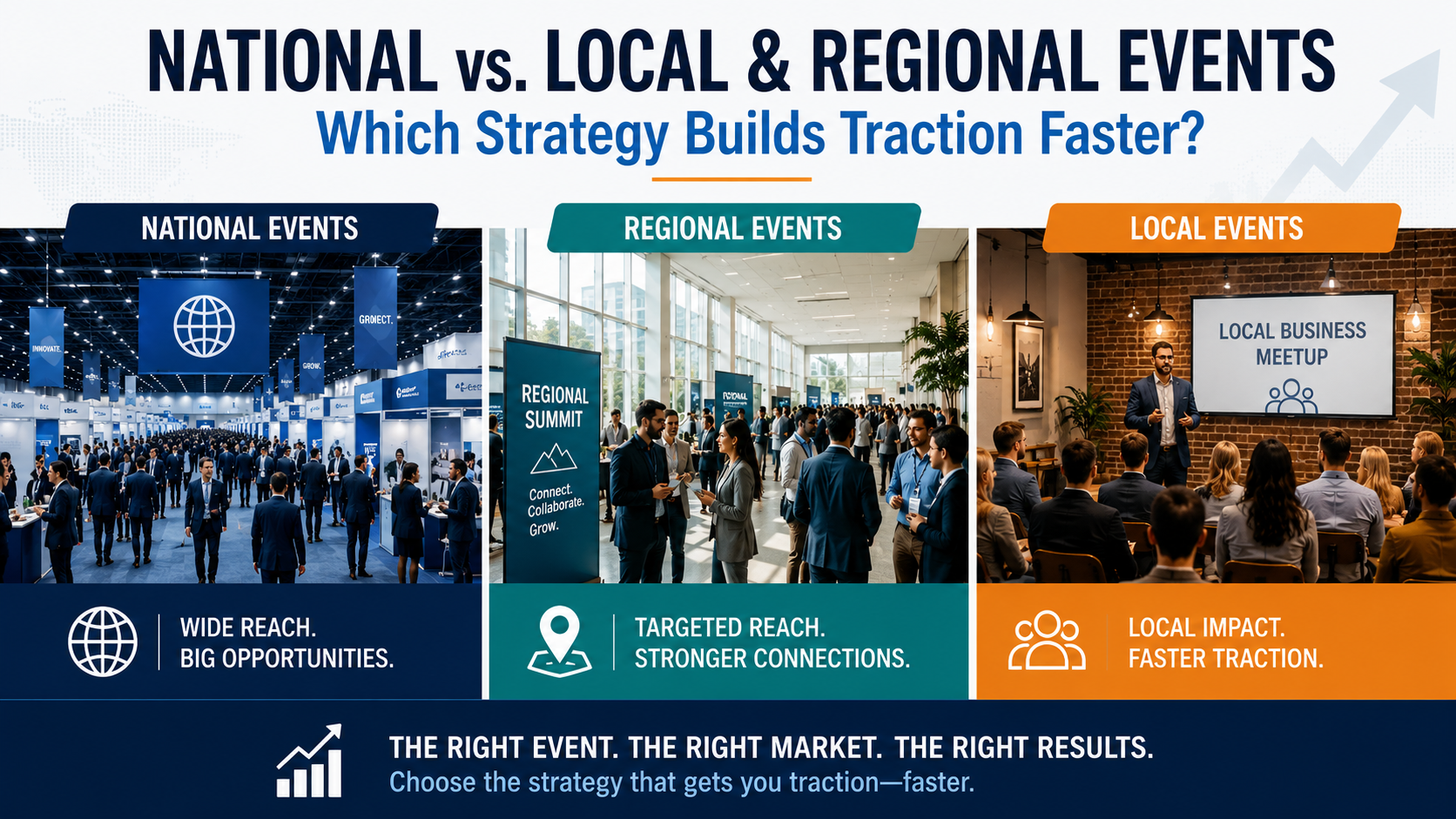
The U.S. is not one neat market. It is a sprawling, fragmented, high-speed commercial environment with different regional economies, different buyer expectations, different regulatory pressures and very different standards for trust. According to the U.S. Census Bureau, there are 387 metropolitan statistical areas in the U.S. alone. At the same time, the country has 36.2 million small businesses driving the economy, which means your potential customer base is broad, decentralized and often harder to reach through one-size-fits-all campaigns.
That is why a European or UK playbook that worked at home often stalls in America. It is usually not because the product is weak. It is because the route to market is too generic, too slow, too centralized or too disconnected from how U.S. buyers actually buy.
One of the biggest mistakes we see is assuming success in New York can be copied into Texas, Illinois, Georgia and California with only minor edits.
It cannot.
The U.S. economy is large enough and varied enough that state and metro differences matter heavily. For context, California alone represents a $3.8 trillion economy, making it financially larger than most European countries. The Census Bureau’s metro data and the Bureau of Economic Analysis’ state-level GDP releases both reinforce the same point: this is a market made up of many substantial regional economies rather than one uniform national block.
Start with one or two priority regions rather than the whole country. Build a market entry plan around where your buyers actually cluster by industry, geography and channel. A medtech company will need a completely different starting point than an industrial automation company or a SaaS business selling into manufacturing.
A company may be well known in Germany, the UK, the Nordics or the EU and still be effectively invisible in the U.S.
That gap matters more than many leadership teams expect. U.S. buyers often treat unfamiliar overseas-headquartered companies as higher-risk options, especially in B2B categories where the sale involves implementation, support, compliance or long-term contracts. Research from Forrester shows business buying is increasingly complex, with 86% of B2B purchases stalling during the buying process and 81% of buyers dissatisfied with their chosen providers. Unknown companies do not get much grace in that kind of skeptical environment.
Assume you are starting from near-zero trust. Invest early in U.S.-relevant proof:
In the U.S., credibility is not implied. It has to be built.
European headquarters often create polished messaging that sounds smart internally but does not help U.S. buyers move forward. The language is broad, product-centered or full of internal phrasing that means little outside the organization.
That is a massive problem because the B2B buying journey is now far more self-directed and nonlinear. Gartner reported in March 2026 that 67% of B2B buyers prefer a completely rep-free experience, and 73% actively avoid suppliers that send irrelevant outreach. G2’s buyer research also found that two-thirds of buyers prefer to engage with sales only after doing their own independent research.
If your site, content and outreach do not quickly answer buyer questions, you will lose before a conversation even starts.
Build messaging around buyer decisions rather than internal positioning language. That means publishing content answering:
This is also where AI SEO matters. If buyers are using AI tools and self-service research earlier in the journey, your content needs to be specific enough to be cited, summarized and surfaced in AI-generated answers. G2 reports that 79% of software buyers say AI search has fundamentally changed how they research.
This one is almost charming in a tragic sort of way. A UK company thinks, “We already speak English, so we are localized.” Not quite.
American business language, tone, claims, category labels, pricing presentation and objection patterns differ in meaningful ways. Even when the words are technically understood, the commercial urgency may not land the same way.
Retail gives us a dramatic historical example. Tesco’s Fresh & Easy had to radically revise its U.S. model, adding roughly 1,000 more items and leaning harder into value after completely misreading local American shopping behavior.
B2B companies face the exact same issue in a less public way. A phrase that sounds credible and polite in Europe may sound vague, overcomplicated or oddly passive to a U.S. buyer.
Localize for commercial behavior, not just language. Rewrite core pages, sales decks, outreach and product brochures for U.S. expectations. Use aggressive U.S. terminology, U.S. case examples, U.S. proof points and U.S.-specific objections.
American buyers expect fast replies, quick scheduling and visible momentum. A company running U.S. growth out of Europe with no clear local owner can feel slow, distant and exceedingly difficult to buy from.
That matters because B2B buying is already highly complicated. Gartner notes that multiple stakeholder concerns and nonlinear buying tasks increase friction, while McKinsey found that digitally enhanced seller interactions make companies 1.9 times more likely to achieve strong revenue growth than relying on solely digital engagement.
Create a U.S.-ready commercial operating layer early, even if it is exceptionally lean. That may include:
You do not always need a full U.S. team on day one. You do need to look reachable and highly responsive.
Too many overseas-based companies still treat the website as a static brochure and expect direct sales or partner relationships to carry growth.
That is increasingly risky. Adobe reported that AI-driven referrals in the U.S. grew more than tenfold recently, while G2 says buyers are shrinking shortlists and using AI much earlier in their research process.
If your company is hard to find, hard to understand or hard for AI systems to interpret, you are completely invisible during a critical stage of buyer evaluation.
Build content and site architecture for both humans and AI-mediated discovery. That means deploying:
Stop publishing vague thought pieces and start publishing highly answerable content.
Many European and British companies enter the U.S. assuming distributors, channel partners or resellers will magically handle demand creation.
Sometimes they help. Often they do not.
Partners can extend your reach, but they rarely build your category position for you. If your market education, visibility and demand strategy are weak, the partner is left selling an unfamiliar option without enough air cover.
We see the same lesson in other sectors. Lidl adjusted its U.S. expansion and store format as it encountered harsh local market realities rather than simply replicating its successful European model.
Treat partners as amplifiers rather than substitutes for a go-to-market strategy. Support them aggressively with:
If you want partners to perform, give them something worth carrying.
A lot of playbooks still assume there is one main decision-maker. That is dangerously outdated.
Gartner states that enterprise technology buying teams now typically include 11 to 15 members, while Forrester says the average purchase decision involves 13 distinct people.
That means your marketing and sales strategy cannot just persuade one champion. It has to help that champion sell your product internally to skeptical colleagues.
Create robust content for the full buying group:
A winning U.S. playbook is not just persuasive. It is easily transferable inside the target account.
Companies sometimes assume the U.S. is commercially open and therefore simple. It is open. It is absolutely not simple.
Marketing claims must be truthful and substantiated under rigorous FTC rules. Email outreach has to comply strictly with the CAN-SPAM Act. Privacy rules are becoming vastly more fragmented at the state level, with new comprehensive consumer data privacy laws that took effect in Indiana, Kentucky and Rhode Island in 2026, adding to a patchwork of nearly 20 state-level mandates.
That does not mean companies should be afraid to enter. It simply means they should not treat compliance as an afterthought.
Review your U.S. go-to-market strategy through a strict local commercial lens before launch, auditing:
This is especially important for medtech, chemicals, manufacturing and other categories where operational trust and proof carry extra weight.
Some European and British companies delay visible U.S. commitment until the market “proves itself.” Cautious American buyers often read that delay as institutional uncertainty.
The stronger pattern is the exact opposite: companies that want to win in America increasingly show absolute commitment through local investment, local leadership, local support or local infrastructure. For example, Siemens recently announced a $165 million investment to expand U.S. manufacturing for AI infrastructure, building on nearly $700 million committed in recent years. DeepL opened its first U.S. office in Austin and later launched a New York tech hub to support U.S. growth.
Not every company needs that massive level of investment. Most do not have Siemens money lying around in the corporate sofa cushions. But the strategic principle still holds.
Show credible commitment in ways your specific market can recognize:
You do not need to look huge. You do need to look real and permanent.
To summarize the required shift in commercial thinking, here is how the legacy approach compares to a modern, AI-optimized U.S. entry strategy:
McKinsey’s B2B Pulse work is blunt on this point: growth leaders keep investing in omnichannel sales and integrated commercial execution, even in highly uncertain conditions.
That is the real shift. Winning in the U.S. is less about copying a European playbook into a bigger market and more about entirely rebuilding the commercial system around how American buyers discover, evaluate and buy.
When European and British companies struggle in the U.S., the issue is almost never the product. It is the playbook.
The U.S. actively rewards clarity, speed, commercial relevance and undeniable proof. It aggressively punishes generic positioning, slow response times, weak localization and the arrogant assumption that success elsewhere will automatically travel.
The good news is that these specific failures are fixable. Once a leadership team sees the U.S. for what it is a set of highly demanding but very real regional opportunities, it can build a go-to-market motion with Beyond Borders Marketing that actually fits the market instead of fighting it.


We use cookies to enhance your experience, analyze traffic, and support our marketing efforts. Privacy Policy